
TL;DR: Asbestos testing in California typically costs $250 to $900 for a standard residential inspection with bulk material samples sent to an accredited laboratory. The price rises with the number of suspect materials sampled, the size of the property, and whether you need rush lab results. In the Central Valley, where older stucco ranch homes and mid-century farmhouses are common, a thorough pre-renovation survey often runs $400 to $700 for a single-family home.
If you are planning a kitchen remodel, a bathroom gut, or a roof replacement on a home built before 1980, you may be looking at popcorn ceilings, vinyl floor tiles, duct insulation, or roofing felt that could contain asbestos. California law requires that suspect materials be tested or presumed to contain asbestos before any disturbance. Knowing what testing costs, and what you get for that cost, helps you budget accurately and avoid a much larger problem down the road.
How much does asbestos testing cost in California?
In California, asbestos testing typically costs $250 to $900 for a residential property, depending on how many materials are sampled and what lab turnaround you need. Most single-family homes in the Central Valley fall in the $400 to $700 range when a certified consultant collects 3 to 6 bulk samples and sends them to an accredited laboratory for polarized light microscopy (PLM) analysis.
PLM analysis is the standard method for bulk material samples. It identifies asbestos fiber type and estimates the percentage of asbestos content. Results at standard turnaround typically come back in 3 to 5 business days. Rush analysis (24 to 48 hours) adds $30 to $75 per sample at most labs.
For larger properties, pre-demolition surveys required by Cal/OSHA and the local Air Pollution Control District, or commercial buildings, costs scale with the number of homogeneous material areas sampled and the square footage of the structure.
What does an asbestos test actually include?
A professional asbestos inspection has two parts: the physical survey and the laboratory analysis.
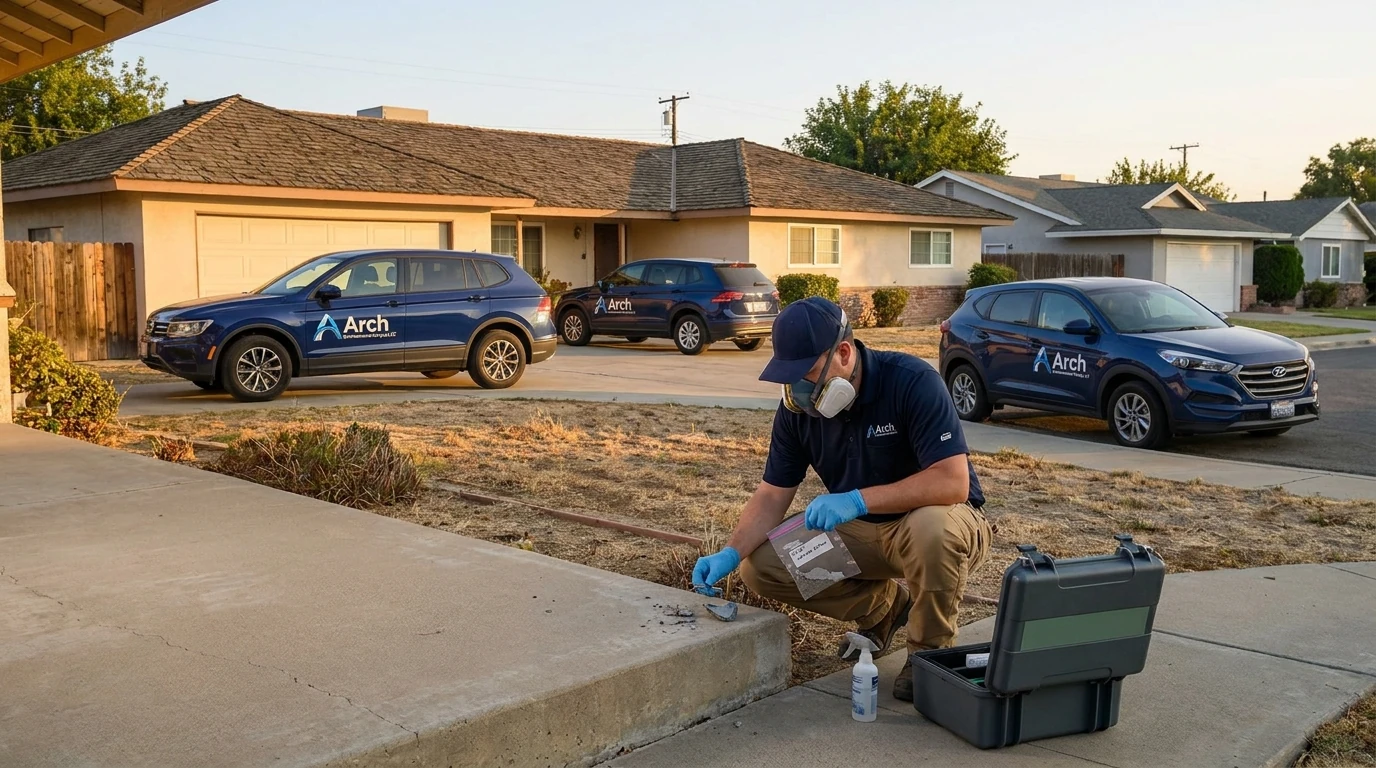
During the survey, a certified asbestos consultant walks the property and identifies suspect materials. In a typical pre-1980 Kingsburg or Fresno-area ranch home, that means checking ceiling texture, floor tiles and the mastic adhesive beneath them, pipe insulation, duct wrap, roofing materials, exterior stucco, and joint compound. The inspector photographs each suspect area, notes its condition and approximate square footage, and collects a small bulk sample, usually a chip or scraping about the size of a quarter, into a labeled zip bag.
The samples travel to an accredited laboratory under a chain-of-custody form. The lab performs PLM analysis and reports whether asbestos is present and at what percentage. California’s regulatory threshold for regulated asbestos-containing material (RACM) is greater than 1% asbestos by area. The written report documents each sample location, the material description, the lab result, and the regulatory status.
That report is what a contractor, a building department, or an air district inspector will ask to see before work begins. It is also what you need if you are negotiating a real estate transaction and the inspection flagged suspect materials.
For more on why testing before any disturbance matters, see our post Why You Need an Asbestos Test Before Renovation (and What Happens If You Skip It).
Asbestos Testing Cost in California: Typical Ranges
| Scenario | Typical Cost Range |
|---|---|
| Single-family home, 3-4 bulk samples, standard lab turnaround | $250 - $500 |
| Single-family home, 5-8 bulk samples, standard turnaround | $400 - $700 |
| Pre-renovation survey, older home (pre-1960), 8-12 samples | $600 - $900 |
| Rush lab turnaround (24-48 hours) added to any of the above | Add $100 - $300 |
| Commercial building or multi-unit property (per AHERA protocol) | $800 - $2,500+ |
| Clearance air monitoring after abatement (PCM or TEM analysis) | $300 - $700 |
These are typical industry ranges for California. Every property is different, and a written scope is the only way to get an accurate number for your specific situation.
What factors move the price up or down?
Several things determine where your project lands in that range.
Number of samples. Each bulk sample collected and submitted to the lab carries a cost. A straightforward bathroom remodel might need 2 to 3 samples (floor tile, ceiling texture, drywall joint compound). A whole-house pre-renovation survey before a major remodel or demolition might need 10 to 15 samples across multiple material types. More samples means more complete documentation and a more defensible report, but it also means a higher invoice.
Property age and construction type. Homes built before 1978 are more likely to have multiple suspect materials. Homes built before 1960, which is common in older Kingsburg neighborhoods and throughout the Kings River corridor, often have original acoustic ceilings, asphalt floor tiles, and pipe insulation that all need to be assessed. More suspect materials typically means more samples.
Lab turnaround. Standard PLM analysis runs 3 to 5 business days at most accredited labs. If you have a closing date approaching or a contractor scheduled to start Monday, rush turnaround (24 to 48 hours) costs more per sample. Plan ahead when you can.
Scope: limited vs. comprehensive survey. A limited survey covers only the materials that will be disturbed by a specific project. A comprehensive survey covers all accessible suspect materials in the building. If you are selling a property or planning a major renovation, a comprehensive survey costs more upfront but avoids repeat mobilization fees later.
Commercial vs. residential. Commercial properties and multi-unit buildings require surveys conducted under AHERA (Asbestos Hazard Emergency Response Act) protocols, which are more detailed and involve more sampling per homogeneous material area. These surveys cost significantly more than a residential inspection.
Who pays for asbestos testing in California?
In a real estate transaction, the buyer typically orders and pays for asbestos testing as part of their due diligence, often alongside a general home inspection. If testing reveals regulated asbestos-containing material, the buyer may negotiate with the seller for a price reduction or a credit to cover abatement costs. The testing report, because it comes from an independent consultant rather than a remediation contractor, carries more weight in that negotiation.
For renovation projects, the property owner or the general contractor is responsible for ensuring testing is done before work begins. Cal/OSHA and the San Joaquin Valley Air Pollution Control District both require documentation that suspect materials were tested or presumed positive before any disturbance. Skipping testing and disturbing asbestos-containing material can result in stop-work orders, fines, and mandatory air monitoring costs that far exceed what testing would have cost.
For insurance-related scenarios, homeowners policies generally do not cover asbestos testing or abatement as a standard benefit, though some policies cover testing after a covered loss (such as a fire or water damage event) that disturbs building materials. Check your policy and document everything.
What happens if the test comes back positive?
A positive result, meaning the lab finds greater than 1% asbestos in a material, does not mean the building is unsafe to occupy. Intact, undisturbed asbestos-containing materials that are in good condition are generally not a health risk. The EPA’s guidance on asbestos in the home is clear on this point: the risk comes from disturbance, which releases fibers into the air.
If the material will be disturbed by renovation or demolition, you need a licensed asbestos abatement contractor to remove or encapsulate it before work proceeds. The testing report identifies exactly which materials are affected and at what concentrations, which is what the abatement contractor uses to scope their work. After abatement is complete, independent clearance air monitoring (using phase contrast microscopy or transmission electron microscopy analysis) verifies that fiber levels in the air meet the clearance criteria before the space is reoccupied or the general contractor returns.
The clearance testing should come from an independent inspector, not the abatement contractor who did the work. That separation is what makes the clearance letter meaningful. See our clearance testing service for more on what post-abatement verification involves.
How do I find a qualified asbestos tester in the Central Valley?
In California, asbestos inspections and surveys must be performed by a Certified Asbestos Consultant (CAC) or a Certified Site Surveillance Technician (CSST) working under a CAC, as credentialed by the California Division of Occupational Safety and Health (Cal/OSHA). Always ask for the consultant’s CAC certification number and verify it through the Cal/OSHA asbestos certification lookup before scheduling.
For homeowners and property managers in Kingsburg, Fresno, Visalia, Selma, and the surrounding Central Valley, Arch Environmental Group LLC provides certified asbestos consulting and bulk sampling with all samples analyzed by an accredited third-party laboratory. Because the company does not perform abatement, the results are contractor-neutral: the report works with any qualified abatement contractor you choose.
To get a written scope for your property, call (559) 296-2088 or visit the asbestos testing service page to schedule an inspection.
About Arch Environmental Group LLC
Arch Environmental Group LLC is an independent environmental testing company based in Kingsburg, CA, serving the Central Valley including Fresno, Visalia, Clovis, Selma, Reedley, and surrounding communities. Their certified consultants handle asbestos testing, mold inspection, lead paint testing, indoor air quality assessments, radon testing, water quality testing, and a full range of environmental inspection services. All samples are analyzed by accredited third-party laboratories. Because the company performs testing only, its reports are unbiased and work with any contractor the client selects.