
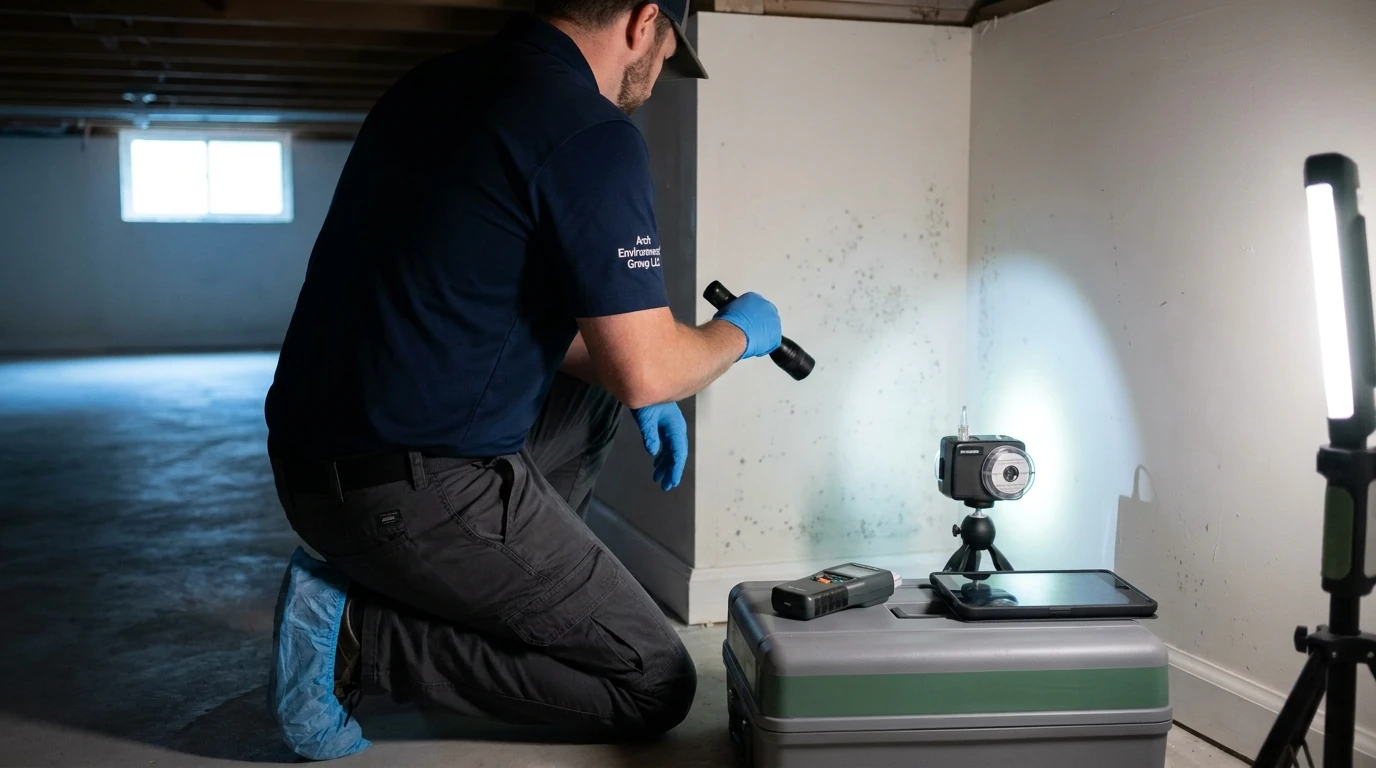
TL;DR: A professional mold inspection in California’s Central Valley typically costs $300 to $700 for a whole-home visual inspection, rising to $500 to $1,000 when air or surface samples are collected and sent to an accredited lab. Clearance testing after remediation runs $300 to $600. What moves the number most: square footage, crawl space or attic access, number of samples collected, and whether thermal imaging is part of the scope.
You noticed a musty smell in the hallway, or your home inspector flagged “possible microbial growth” in the crawl space, or your kid has been coughing since you moved in. Now you’re trying to figure out what a professional mold test actually costs before you call anyone. The answer depends on what kind of inspection you need and how many samples the situation calls for. Here is a plain breakdown of what Fresno County and Tulare County homeowners are paying in 2026, and what drives the price up or down.
How Much Does a Mold Inspection Cost in California?
In California, a professional mold inspection typically costs $300 to $700 for a whole-home visual inspection, and $500 to $1,000 when lab-analyzed air or surface samples are included. Spot inspections of a single area run lower, around $150 to $300.
Those ranges reflect what independent environmental testing firms charge across the Central Valley region. The EPA notes that sampling is not always necessary and should be paired with a thorough visual inspection and moisture assessment. A reputable inspector will tell you how many samples the situation actually warrants rather than collecting as many as possible.
| Inspection Type | Typical Cost Range (CA) |
|---|---|
| Spot inspection, one area, no samples | $150 - $300 |
| Whole-home visual inspection | $300 - $700 |
| Whole-home inspection + 2-3 air samples | $500 - $900 |
| Whole-home inspection + 4-6 air samples + surface samples | $700 - $1,000 |
| Clearance testing after remediation | $300 - $600 |
| Post-flood or post-water-damage assessment | $400 - $800 |
These are industry-typical ranges, not a quote. Every property is different. A written scope before any work begins is the only way to know your actual cost.
What Makes the Price Go Up or Down?
Five factors drive most of the variation in mold inspection pricing.
Square footage. A 1,100-square-foot Kingsburg bungalow takes less time to survey than a 2,800-square-foot Fresno home with a finished basement and a detached garage. Larger homes mean more rooms to document, more potential moisture sources to probe, and more time on-site.
Crawl space or attic access. Central Valley housing stock built in the 1960s through 1980s often has a vented dirt-floor crawl space under the main living area. Inspecting that space requires a respirator, a headlamp, and extra time. If the crawl space is the suspected problem area, expect this to add $75 to $150 to the base scope.
Number of samples collected. Each air sample collected with a spore trap cassette, the small plastic cartridge an air pump draws air through for a set time, typically adds $75 to $150 per sample once lab analysis is factored in. Surface samples (tape lifts or swabs) run similarly. A standard whole-home inspection might call for two to four air samples plus an outdoor baseline sample for comparison. The outdoor baseline matters: the EPA recommends comparing indoor spore counts to outdoor levels to determine whether indoor concentrations are elevated.
Lab turnaround tier. Standard lab turnaround from an accredited laboratory is typically 3 to 5 business days. Rush analysis (24 to 48 hours) costs more, usually $30 to $75 extra per sample. If your real estate option period closes Friday, rush turnaround may be worth the premium.
Thermal imaging. Some inspectors carry a thermal camera to locate cool, damp wall cavities that a moisture meter alone might miss. When thermal imaging is included in the scope, expect to add $100 to $200 to the base price. It is a useful tool for older homes with stucco exteriors or interior walls that have had prior water intrusion.
What Does the Inspection Actually Include?
A professional mold inspection is a structured, documented process. Here is what each phase covers.
1. Pre-inspection interview. The inspector asks about the history of the property: any past water leaks, roof repairs, plumbing failures, or HVAC issues. This narrows the areas to prioritize.
2. Visual inspection and moisture mapping. The inspector walks the property with a moisture meter, probing walls, floors, and ceilings near windows, plumbing fixtures, and the HVAC system. Elevated moisture readings (generally above 16% in wood framing, though thresholds vary by material) flag areas for closer attention.
3. Sample collection. If the visual inspection reveals suspect areas or elevated moisture, the inspector collects air samples and, where visible growth is present, surface samples. Each sample is logged with a location, time, and pump flow rate on a chain-of-custody form that travels with the sample to the lab.
4. Laboratory analysis. Samples go to an accredited third-party laboratory for analysis under a microscope. Air samples are read as spore counts per cubic meter by genus (Cladosporium, Aspergillus/Penicillium, Stachybotrys, etc.). Results typically return in 3 to 5 business days at standard turnaround.
5. Written report. The inspector delivers a written report with the findings, moisture readings, sample results, photos of suspect areas, and recommendations. A good report is contractor-neutral: it documents what was found and what action, if any, is warranted. It does not steer you toward a specific remediation company.
For a deeper look at how air and surface sampling differ and when each is appropriate, see Air Sampling vs Surface Sampling for Mold: Which One Do You Actually Need?
Does Mold Testing Cost More for Apartments or Rental Units?
Mold inspection costs for apartments and rental units are similar to single-family homes on a per-unit basis, but the situation is often more complicated. A tenant who suspects mold in one unit may only need a spot inspection of the affected area ($150 to $300). A landlord or property manager assessing a multi-unit building for a sale or insurance claim will pay more because the scope is larger.
In California, the California Department of Public Health provides guidance on mold in rental housing, including landlord obligations. A written inspection report from an independent tester, one who has no financial stake in the remediation outcome, is the document that holds up if a dispute goes to mediation or court. That independence is the reason an environmental testing firm and a remediation contractor should never be the same company.
What Happens If the Results Come Back Elevated?
If lab results show indoor spore counts significantly above the outdoor baseline, or if visible growth is confirmed, the next step is hiring a qualified mold remediation contractor to scope and perform the work. The inspection report you receive is contractor-neutral: it documents the findings and works with any qualified contractor you choose.
After remediation is complete, independent clearance testing confirms the work was done correctly. Clearance testing, typically $300 to $600, involves collecting post-remediation air samples in the affected area and comparing them to outdoor baseline levels. Because clearance testing verifies the remediator’s work, it should come from a different company than the one that did the remediation. That separation is what makes the clearance letter credible to a buyer, a lender, or an insurer.
For more on this, see Why Your Mold Tester Should Never Be Your Mold Remover.
Is a DIY Mold Test Kit a Cheaper Alternative?
DIY mold test kits sold at hardware stores cost $10 to $50, but they answer a different question than a professional inspection. A DIY petri-dish kit tells you that mold spores are present in your home, which is true of virtually every home. It does not tell you the species, the concentration relative to outdoor levels, the source, or the moisture conditions driving growth. The result is almost always “mold detected,” which leaves you no better informed about whether you have a problem or how serious it is.
For a full comparison of what each approach actually delivers, see DIY Mold Test Kits vs a Professional Inspection: What the Lab Report Won’t Tell You.
What Should You Do Next?
If you have a musty odor, visible staining, a history of water intrusion, or a real estate inspection report flagging possible microbial growth, the next step is a professional inspection with lab-analyzed samples. That gives you a defensible, documented answer rather than a guess.
Schedule a mold inspection with Arch Environmental Group LLC by calling (559) 296-2088 or visiting the mold inspection and testing service page. The company is locally owned and operates throughout Fresno County, Tulare County, and the surrounding Central Valley. Because Arch Environmental Group LLC does not perform mold remediation, there is no incentive to find problems that are not there. The report documents what is present and works with any qualified contractor you choose.
About Arch Environmental Group LLC
Arch Environmental Group LLC is an independent environmental testing company based in Kingsburg, CA, serving Fresno, Visalia, Clovis, Selma, Reedley, Tulare, and surrounding Central Valley communities. The company is licensed and insured, with certified inspectors holding credentials as a Certified Asbestos Consultant, Lead Inspector Assessor, and NIOSH 582 Microscopist. Services include mold inspection and testing, indoor air quality testing, asbestos testing, lead paint testing, water quality testing, clearance testing, radon testing, VOC and formaldehyde testing, allergen testing, HVAC and duct assessments, post-flood mold assessment, sewage contamination assessment, remediation oversight, environmental site assessments, compliance consulting, and litigation support sampling. All samples are analyzed by accredited third-party laboratories.